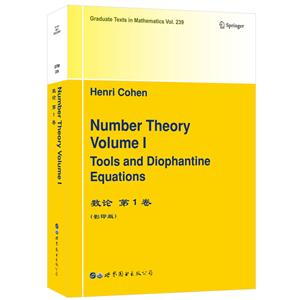

作者:(法)H.科恩
页数:596
出版社:世界图书出版公司
出版日期:2019
ISBN:9787519255282
电子书格式:pdf/epub/txt
内容简介
《数论》分为2卷,是Springer“数学研究生教材”丛书之239和240卷,是一套面向研究生的数论教程,主旨是全面介绍丢番图方程的解,包括多项式方程、有理数和代数数论等,其中特别强调了算术代数几何的现代理论。全书各章共有530例习题,部分习题有提示。
本书是其中的第2卷,由H.科恩著。共分2部分8章,内容包括伯努利多项式与伽玛函数、Dirichlet级数和L-函数、p-adicγ和l-函数、线性形式在对数中的应用、高亏格曲线上的有理点等。
作者简介
这套经典研究生教材的作者作者Henri Cohen(H.科恩,法国), 是法国Institue de Mathématiques de Bordeaux的教授。
本书特色
《数论》分为2卷,是Springer“数学研究生教材”丛书之239和240卷,是一套面向研究生的数论教程,主旨是全面介绍丢番图方程的解,包括多项式方程、有理数和代数数论等,其中特别强调了算术代数几何的现代理论。全书各章共有530例习题,部分习题有提示。
目录
2
15.3.5 The Equation x2 = yP + zp for p > 7
15.4 An Occasional Bound for the Exponent
15.5 An Example of Serre-Mazur-Kraus
15.6 The Method of Kraus
15.7 “Predicting Exponents of Constants”
15.7.1 The Diophantine Equation x2 – 2 = yP
15.7.2 Application to the SMK Equation
15.8 Recipes for Some Ternary Diophantine Equations
15.8.1 Recipes for Signature (p, p, p)
15.8.2 Recipes for Signature (p, p, 2)
15.8.3 Recipes for Signature (p, p, 3)
16. Catalan’s Equation
16.1 Mihailescu’s First Two Theorems
16.1.1 The First Theorem: Double Wieferich Pairs
16.1.2 The Equation (xp – 1)/(x – 1) = pyq
16.1.3 Mihailescu’s Second Theorem: p | hq and q | hp
16.2 The + and – Subspaces and the Group S
16.2.1 The + and – Subspaces
16.2.2 The Group S
16.3 Mihailescu’s Third Theorem: p
15.3.5 The Equation x2 = yP + zp for p > 7
15.4 An Occasional Bound for the Exponent
15.5 An Example of Serre-Mazur-Kraus
15.6 The Method of Kraus
15.7 “Predicting Exponents of Constants”
15.7.1 The Diophantine Equation x2 – 2 = yP
15.7.2 Application to the SMK Equation
15.8 Recipes for Some Ternary Diophantine Equations
15.8.1 Recipes for Signature (p, p, p)
15.8.2 Recipes for Signature (p, p, 2)
15.8.3 Recipes for Signature (p, p, 3)
16. Catalan’s Equation
16.1 Mihailescu’s First Two Theorems
16.1.1 The First Theorem: Double Wieferich Pairs
16.1.2 The Equation (xp – 1)/(x – 1) = pyq
16.1.3 Mihailescu’s Second Theorem: p | hq and q | hp
16.2 The + and – Subspaces and the Group S
16.2.1 The + and – Subspaces
16.2.2 The Group S
16.3 Mihailescu’s Third Theorem: p